
From Arthur Schopenhauer:
“All truth passes through three stages. First, it is ridiculed. Second, it is violently opposed. Third, it is accepted as being self-evident.”
This quote speaks to the idea of how new ideas or concepts are initially met with skepticism or resistance, but over time, they gain acceptance and are seen as obvious truths.
And in the words of Machiavelli:
“It ought to be remembered that there is nothing more difficult to take in hand, more perilous to conduct, or more uncertain in its success, than to take the lead in the introduction of a new order of things. Because the innovator has for enemies all those who have done well under the old conditions, and lukewarm defenders in those who may do well under the new.
The Background Story:
One early morning in March, 2018, a Tesla driver operating on autopilot while playing on his mobile phone, failed to navigate past a crash cushion protecting a concrete barrier (K-rail; Jersey Barrier). The vehicle strikes the barrier at high speed and he perishes. A tragic event. He should have survived the impact. Crash cushions (attenuators in the vernacular) are very effective at mitigating serious injury.
Subsequent investigation reveals that the crash cushion had been struck and damaged weeks earlier. It had not been repaired at the time of the Tesla impact. In fact, the DOT’s defense was that they simply were unaware of the damage. A law enforcement officer did report the damage to his dispatch while assisting the previous incident that resulted in the damaged safety barrier, but the message was not forwarded to maintenance personnel. The safety device had not been repaired and failed to protect the driver involved in the 2nd impact.
Several lessons learned from this tragedy were:
- There is no real-time reporting system to notify personnel when critical roadway safety devices are struck and damaged. At least nowhere on planet Earth. DOTs rely upon passive detection; crews picking up litter, law enforcement reporting; maintenance personnel incidentally driving by, etc.
- Once struck, all safety barriers must be inspected and likely repaired. They only work once. A compromised barrier is a liability.
- “Nuisance” impacts occur frequently. “Nuisance” doesn’t speak to severity, only that it was otherwise unreported. It may have been a significant crash, however, lack of communication or the vehicle may have proceeded several 100 meters before coming to a stop. In this later case, the responders may not even realize that the infrastructure upstream has been damaged. Delays may be attributed to spare parts, but at least the responsible entity is aware of the potential danger. It is the pernicious nuisance impact that is the killer. You can’t fix what you don’t know. And not knowing, according to the National Transportation Safety Board (NTSB) that studied this event, is no excuse.
Why Impact Detection is Coming to a Roadway Near You!
The Iowa Department of Transportation, aware of the trend towards Intelligent Transportation Systems and road sensors, has undertaken a pilot program to evaluate impact sensors and the value proposition. The pilot program, running over 12 months, has incorporated 10 sensors on crash cushions that are “frequent flyers,” that is, often hit.
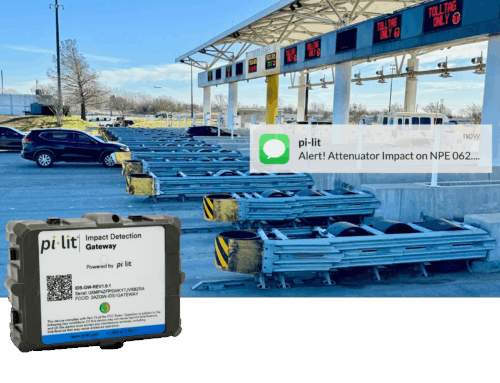
Over the last 10 months, many impacts have been detected. The system under study, the IDS™ (Impact Detection System™) by pi-Lit®, can differentiate severity of impact; minor, moderate, severe, allows for remote adjustment of sensitivity; integration with Waze and Apple Maps to alert approaching drivers of an event; notifies appropriate maintenance personnel in real time; documents location and time-of-day; and can integrate with existing systems that an agency uses.
Experience in Florida, Texas, California, Tennessee, as well as Iowa has revealed that nuisance impacts are common and that damage is often unreported for weeks. The projects in each of the states were designed to establish the value proposition and accuracy of this new technology. And to answer a simple question: Save for the impact sensor, would the DOT have known, and how quickly might they have learned of a damaged asset? The answer is as anticipated. Absent a formal reporting system, all bets are off!
Below are illustrations of three real-world events that illustrate how effective and life-saving crash cushions are, and how dangerous they may be if not repaired.
“A Rude Awakening”
This lucky driver was clearly asleep at the wheel, either traveling home from, or to work early in the morning. The video is quite impressive. No swerve, no braking. More impressive is that the DOT, with many road cameras, was alerted by the sensor of the impact, time, and location. They then played back the recording from a camera near the location and saw the event. Absent the sensor, they would not have known of the event until some time later, and would not have known when the event took place. This would have made reviewing hours or days of video quite challenging.
Miscommunication Happens; We’re Human Afterall
The action is in the left upper aspect of this camera field. It’s easy to miss. A dark colored vehicle is seen crossing lanes to exit, but strikes the attenuator. The only indication is that you see the vehicle cross on to the grass, but fails to drive past the pole blocking the view.
Now here is the real skinny. Notice that in front of the vehicle (that can’t be seen) is an end treatment. On the grass. Take note of this end treatment.
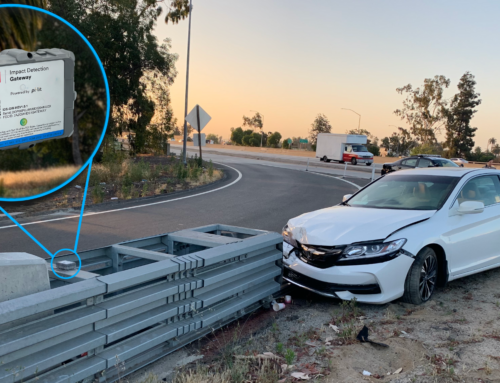
Law enforcement showed up to aid the disabled vehicle and a call was made to dispatch to report the vehicle on the roadside. It was assumed that the event occurred where the car was found instead of upstream at the gore point, where the crash cushion had been struck.
In this incident there was no reported damage by the on-scene traffic safety personnel due to the final position of the automobile being down the embankment further down the off ramp. Absent the impact detector providing the GPS location, the time of day, and the alert, the DOT may not have known that the crash cushion upstream at the gore point was struck and in need of inspection and repair. In this incident while not requiring repair, the crash cushion had to be reset to being crash worthy.
Things that go Bang at Night go Unreported
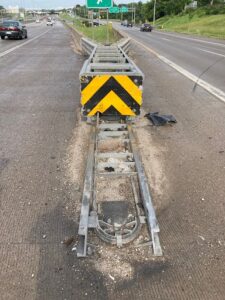
Another lucky Iowa driver. This one at 04:04 am. Possibly asleep, more likely texting or checking their navigation map for directions, because we see a last minute attempt to swerve out of the way.
Of interest with this event is that the driver was able to continue for several hundred meters before coming to a stop. These types of incidents often go overlooked. No one was around to report that the crash cushion was hit. Once again, if not for the sensor providing the time-stamp, GPS location, and alert, the DOT may not have been able to play back the recorded video to identify the impact and inspect the safety device in a timely manner. In this incident, about 14 mins after the impact detection notification law enforcement arrived at the crash cushion and performed an inspection of the cushion.
The crash cushion in this incident did sustain some damage and the crossbar had to be realigned and repaired. In this incident, the Iowa DoT was able to repair it quickly and get it back to being crash worthy. This example is a classic example of a nuisance impact that would have otherwise gone unnoticed without an impact sensor.
“I didn’t know” is not an effective defense. Nor is “What I don’t know won’t hurt me.”
A common stance of the DOT is what is referred to as “The Ostrich approach to business.” Fortunately, there are states that take their charter seriously and, once identified, correct systems that need correction. And the plaintiffs Bar is well aware that low-cost sensors are available today to prevent injury upon a second impact. The NTSB published a report regarding the California 2018 event and suggested that the state(s) have a responsibility to monitor and repair critical safety devices in a timely manner.
A look ahead to a connected infrastructure future: Giving a voice to asphalt
Cars are smart as moon landers; roads are as dumb as a sack of rocks. Sensors like the pi-Lit Impact Detection System IDS(™) are changing this. Giving a voice to asphalt is necessary if Vision Zero (reducing highway deaths) is to achieve its goal. Each mile of road cost tens of millions of dollars to construct. Sensors cost less than $0.90 (90 cents) a day. Roads can be made smart and able to participate for less than the cost of the coffee spilled each day in the DOT office.
Show me the money: Revenue Recovery
Not common knowledge amongst the driving public, but well understood by the state, is that damage that you impart upon infrastructure is your responsibility. If identified, your car insurance is billed for the cost of repair. The state’s challenge, however, is when a nuisance impact occurs, the car is most often gone. The tow driver took it away, the car could drive away, or law enforcement issued a citation or a tag on a disabled, abandoned vehicle. In all of these cases, the DOT likely did not receive information identifying the driver or insurance.
With an impact sensor pinging an alert (via text or email) within seconds of the impact, local maintenance facilities can dispatch a driver to quickly arrive at the site. And in many cases thus far the driver can be identified and insurance information collected.
Altruism versus economy; does it really matter?
The return on investment of roadway sensors is real and quick, whether in the form of operating expense reduction (revenue recovery) or lives saved. Both seem like a good deal.
Summary:
Doing the right thing pays off. In a big way. Technology is often expensive and searching for an application rather than a need seeking a solution. Knowing when critical safety devices are damaged is a need deserving a solution. And doing it inexpensively makes it more fun. Ubiquity through economy is the goal.
Learn More about our Impact Detection System